




Discharge coefficients, free, effective and equivalent areas
|
| https://www.gov.uk/government/publications/classvent-and-classcool-school-ventilation-design-tool |
Contents |
[edit] Introduction
The terms free area, effective area, equivalent area and discharge coefficient are similar, and can at times be poorly, incorrectly or mistakenly calculated. This has the potential to become increasingly significant as the impacts of climate change and the need for adaptation increase.
The Building Regulations Part O comes into force from June the 15th 2022, and refers to all three terms, requiring their consideration in meting the requirements of the approved document Part O.
[edit] Free area
Free area (Afree) is the geometric open area of a ventilation opening. It is quite simply the height and width of the opening multiplied to give the open area. W x H = A or Afree. 'This area assumes a clear sharp-edged orifice that would have a coefficient of discharge (Cd) of 0.62'
[edit] Effective area
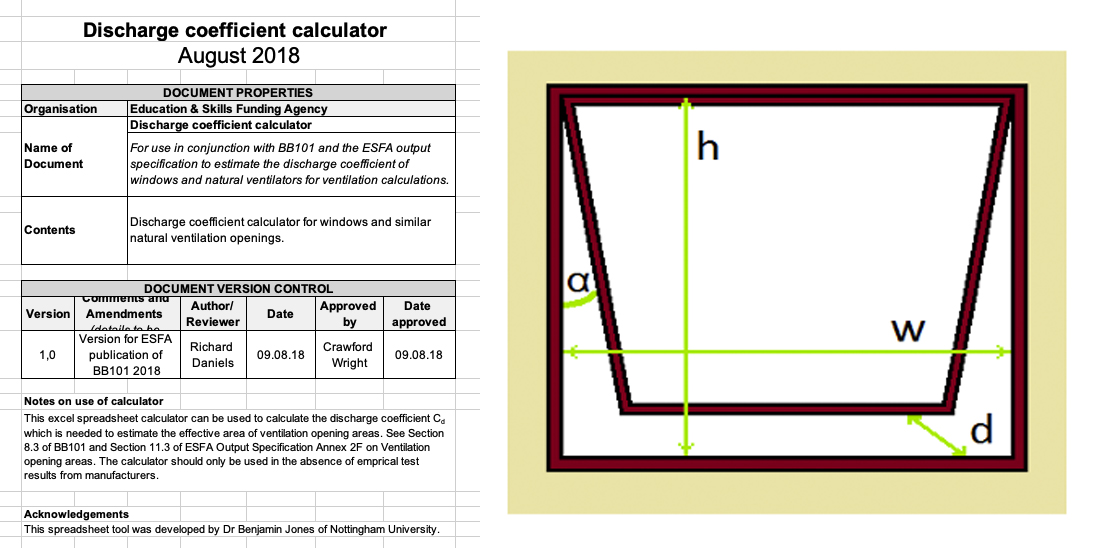
Effective area (Aeff) is the area through which air flows after the resistance of airflow has been taken into account. The effective area is the free area described above multiplied by the discharge coefficient (Cd). Afree x Cd = Aeff. The discharge coefficient includes the angle of the opening as one of its factors.
[edit] Equivalent area
Equivalent area (Aeq) is a measure of the aerodynamic performance of an opening. It is the area of a sharp-edged circular orifice through which air would pass at the same volume flow rate, under an identical applied pressure difference, as through the opening under consideration. This is the effective area divided by the orifice discharge coefficient (Cd0) which assumes a clear sharp-edged orifice would have a coefficient of discharge (Cd) of 0.62. or Aeff / Cd0 = Aeq)
[edit] Discharge coefficient
In practice, a constant value of discharge coefficient is often used for simplification, this is basically a ratio of the actual discharge to the ideal discharge. However, a constant value of discharge coefficient can lead to deceptive airflow estimations in different window designs.
[edit] Orifice discharge coefficient
The orifice discharge coefficient (Cd0) is somewhat more accurate and gives a figure for a specific window considering also the slope or angle of plane and other adjustments.
[edit] Recommended tool
The buildings regulations recommend using a tool to assist in assessing these figures when it comes to the simplified method of Part O. The tool is referred to as the 'discharge coefficient calculator ' and was written in 2018 as part of the guidance on school design that formed BB101.
The simple tool can be downloaded here: https://www.gov.uk/government/publications/classvent-and-classcool-school-ventilation-design-tool
[edit] Related articles on Designing Buildings
Featured articles
Check out some of the best features and news from Designing Buildings as well as key stories from around the web.

Bringing together expertise and creating cultural benefits.

CIOB celebrates positive Ofsted report.

The Building Safety Regulator announces a call for evidence.

Government approach could undermine delivery and regeneration.
World's first mass timber data centre.

The overlooked environmental aspect of data centre development.
Introduction to radon awareness

New technical information sheet published by CIOB.

Updated supplier guide can help electrical contractors engage with NHP.

CIAT confirm the winners of the 2026 architectural technology awards.

Government launches a one stop shop for flood preparedness.

Sir Edwin Lutyens: Britain's greatest architect? Book review.

CIOB publishes free template to help assess and manage risks.
ECA's reflections on Party Conference season

Burnham wants to be confident of winning before asking for a fresh mandate.